|
|
||||||||
| |
|
|
|
|
|
|
|
|
| |
||||||||
| |
||||||||
| |
 |
||||
| |
 |
||||
| |
|
||||
|
|
ROMAN INDUSTRYThe Roman occupation of Britain for nearly four hundred years brought about a great leap in the advancement of technological, industrial and craft skills. The Romans were masters of most branches of craft and technology. Consequently, the native population was quick to acquire and copy new skills transforming daily life.
The Romans introduced new methods of civil engineering, house-building, metal working and pottery manufacture. Other Roman crafts and industries included carpentry, stonemasonry, bone working, spinning and weaving, tile making and quarrying and mining. Because the Dartford area was principally the focus for an agricultural-based economy, industrial activity was not well represented in and around the Darent Valley. Archaeological excavation of key Roman sites has revealed the presence of tanning, fulling and pottery manufacture. |
||||
 |
|||||
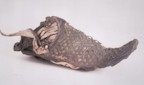
TANNINGThe Romans used leather for all sorts of purposes including the manufacture of clothes, shoes, and horse harness. The remains of a tannery pit were discovered by archaeologists at Lullingstone Roman Villa, providing first-hand evidence of an interesting industrial activity. Further evidence for the local tanning industry was found on the site of Northfleet Villa. There were six main stages involved in the tanning of skins. Firstly, the skins had to be thoroughly washed and soaked in water for the removal of blood and the cleaning of the outer surface. After washing, the skins were immersed in a potent mixture of lime and water to loosen the hair which could then be scraped away. The process of fleshing then took place; fat from the underside of the skin was scraped away with a knife. A second washing process was undertaken to remove any traces of lime. The actual tanning process involved the laying of the skins in a vat or pit containing vegetable liquor of varying strength, for varying periods. Finally, the skins were removed from the tanning pit, coated in oil and hung in a current of air to dry slowly. The Lullingstone tannage pit was dug into natural chalk and lined with clay so that it retained liquid. A leather sheet was spread over the bottom of the pit and over thirty old leather sandals added to promote the tanning process. Once prepared, the pit was filled with a strong solution of water and acid juices from fruit that had probably been pulped for the purpose. Archaeologists found large quantities of seeds, pips and fruit-stones in the remains of the pit. Fruit identified included sloe, bird-cherry and cherry-plum. The tannery was equipped with its own drainage system, pipes and gullies. The presence of pottery in the tannage pit helped to date it to the last decade of the second century or the very early third century A.D. It would seem that the villa at Lullingstone became temporarily abandoned c. A.D. 200, so the short-lived tanning industry may have existed after the resident family had moved out of the villa.
|
|||||
|
|||||
FULLINGAt Darenth Roman Villa was found a system of large tanks and hypocausts. These were probably connected with either the fulling or dyeing of woollen cloth, suggesting that sheep farming formed a major part of the villa’s economy.
|
|||||
|
|||||
POTTERY MANUFACTURE
Pottery kilns of Roman date are well known throughout southern England. Kilns were basic and easily constructed for the purpose of manufacturing coarse kitchen pottery. In general, Roman pottery kilns were little more than ovens, usually partly below ground-level and depending on the type of pottery required, had different types of flues and supports for the pottery undergoing firing.
|
|||||
|
|||||
THE KILN SITE AT ASHA number of Roman kiln sites have been found close to Dartford and the Darent Valley, most notably on the site of Ash Roman Villa and at Joyden’s Wood. The remains of a Roman villa, associated kiln and rubbish pit, and a cremation burial site were discovered by the Fawkham and Ash Archaeological Group in the Westfield neighbourhood of New Ash Green. The kiln site, adjacent to a ditch system close to the villa building, was excavated in 1976, and was found to date from the late first to early second century A.D. The kiln firing chamber at Ash was roughly circular with a kiln floor sunk below the ground surface. Just below ground level, the kiln wall was partially lined with broken tile. It is probable that the tile served as a ledge or platform to support the pottery that was being fired. Evidence suggests that this kiln was used in the manufacture of a grey ware imitation of popular north Kent coarse ware of the early second century A.D.
|
|||||
|
|||||
THE JOYDEN'S WOOD KILN SITEExcavations at Joyden’s Wood in 1951-53 indicated the former existence of a Romano-British settlement occupied mainly during the second century A.D., but with evidence of occupation again in the fourth century. No actual buildings or hut sites were found, but a number of filled-in ditches and a kiln site were located. It was not entirely clear whether the kiln was used for the manufacture of pottery or for the roasting of corn (to prevent the corn from germinating).The Joyden’s Wood kiln consisted of a roughly circular pit about three feet in diameter with a flat bottom over three feet below the surface. The vertical sides were lined with burnt clay. Leading into the pit was a narrow clay-lined trench - the remains of the firing tunnel. Over the whole kiln there may have been a clay dome enclosing the pottery vessels stacked for firing. Clay required for the manufacture of pottery could have been obtained just a few yards away from the kiln.
|
|||||
Next topic: Saxon industry
|
|||||
|
|||||
 |
|
||||